
Designing Uncertainty: Architecture in an Era of Constant Change


Let us imagine a world in which change is no longer the exception, but the rule. We are living in an era of extreme unpredictability: climate conditions are intensifying through record-breaking heat waves and increasingly frequent extreme events; economies fluctuate between recessions and AI-driven booms; and technology is reshaping the way we inhabit space, from remote work to augmented reality embedded within our cities.
Within this context, a fundamental question emerges: how do we design for the unpredictable?How can we conceive buildings and cities that do not merely withstand uncertainty, but actively thrive within it?
Today, architecture is explored not as a permanent object, but as a living strategy—one capable of anticipating, adapting, and evolving in response to constant change.
Flexible and Adaptive Architecture
Rigidity belongs to the past. Contemporary design is grounded in modularity and reconfigurability as core principles. “Plug-and-play” systems enable spaces to evolve over time through movable partitions, raised floors prepared for future services, and façades capable of responding to varying uses or seasonal conditions.
A paradigmatic example is the Palais de Tokyo in Paris, whose renovation (2012) embraced deliberately “unfinished” spaces without fixed hierarchies. This open infrastructure—featuring exposed services and easily reconfigurable systems—allows exhibitions to transform into workshops, auditoriums, or temporary offices without major construction work. The result is not only spatial flexibility, but also a significant reduction in long-term adaptation costs, demonstrating that flexibility is not an aesthetic choice, but an economic and operational strategy.

Hybrid Spaces and Open Programs
Buildings can no longer respond to a single, fixed use. Uncertainty demands hybrid spaces capable of integrating living, working, leisure, and care. This condition became particularly evident during pandemics, migration crises, and accelerated shifts in labor patterns.
Polyvalence becomes a critical asset: a space functioning as a cultural venue during the day can be repurposed as emergency infrastructure at night. Architecture ceases to be a static container and becomes a platform adaptable to social context and evolving needs.

Designing for Future Scenarios (Future-Proof Design)
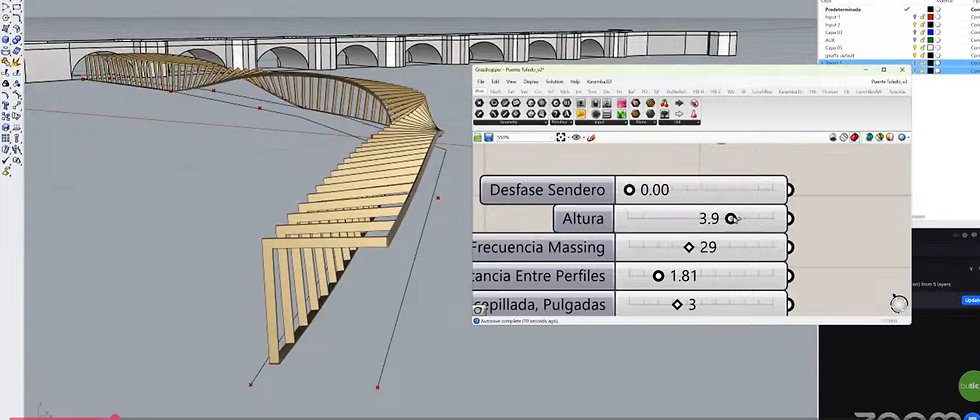
Designing for the future is no longer an intuitive exercise, but a simulation-based process. Future-proof design employs artificial intelligence, parametric modeling, and data analysis to test multiple climatic, demographic, and energy scenarios prior to construction.
Tools such as Grasshopper allow designers to evaluate dozens—or even hundreds—of variations of a single project, anticipating performance and mitigating risk. Architecture shifts from reacting too late to strategic anticipation.
Urban and Architectural Resilience
Resilience extends beyond structural performance. It integrates social, ecological, and economic dimensions. Cities that have experienced extreme events have learned that resistance alone is insufficient; adaptation and regeneration are essential.
In local contexts, post-disaster and post-pandemic experiences have encouraged low-carbon construction systems, community participation, and the use of bio-based materials. Resilience is measured not only by physical strength, but by a community’s ability to reorganize and remain functional in the face of adversity.

Post-Disaster, Pandemic, and Migration Scenarios
In a fluid world, the value of design does not lie in the permanence of a fixed object, but in the adaptability of a living strategy. Architecture must anticipate, absorb, and reinvent itself—operating more like an ecosystem than a statue.
Let us turn uncertainty into a catalyst. Let us design cities capable of responding to climate change, accommodating migration, and absorbing technological innovation.The question is no longer whether change will arrive, but whether we are ready to lead it through design.
As Rem Koolhaas reminds us:
“Architecture is the strategy of change.”