
Architecture Without Borders: Latin American Roots in Florida Design

Designing Where You Are, Without Forgetting Where You Come From

For a long time, Latin American architecture has been misunderstood as an aesthetic language — colors, textures, and “tropical” forms.
But that interpretation is superficial.
True Latin American architecture — especially Ecuadorian architecture — is not defined by how it looks, but by how it responds to place. It is an architecture born from adaptation: to climate, territory, and available materials.
And that is where a far more interesting conversation begins.
More Than Style: A Logic of Adaptation

In Ecuador, as in much of Latin America, architecture does not emerge from form, but from necessity:
Thermal walls that respond to climate
Cross ventilation strategies that reduce heat
Interior courtyards that organize daily life
Local materials such as earth, stone, and wood
This is not “vernacular” architecture in a romantic sense.
It is architecture that is efficient, rational, and deeply connected to its environment.
Even today, contemporary projects continue to operate under these principles, reducing thermal loads and improving comfort without relying heavily on complex mechanical systems.
The Challenge: Designing in Florida

When this logic is brought into Florida, the context changes… but not as much as it may seem.
Florida also demands adaptation:
Humid tropical climate
Intense solar exposure
Constant ventilation
Strict hurricane-resistant building requirements
And yet, much of residential development continues to fall into the same pattern:a generic, repetitive “tropical” aesthetic with little identity.
The question, then, is not:
How do we create Latin American architecture in Florida?
The real question is:
How do we apply its logic of adaptation within a new context?
Cluster Housing: An Opportunity to Do Things Better
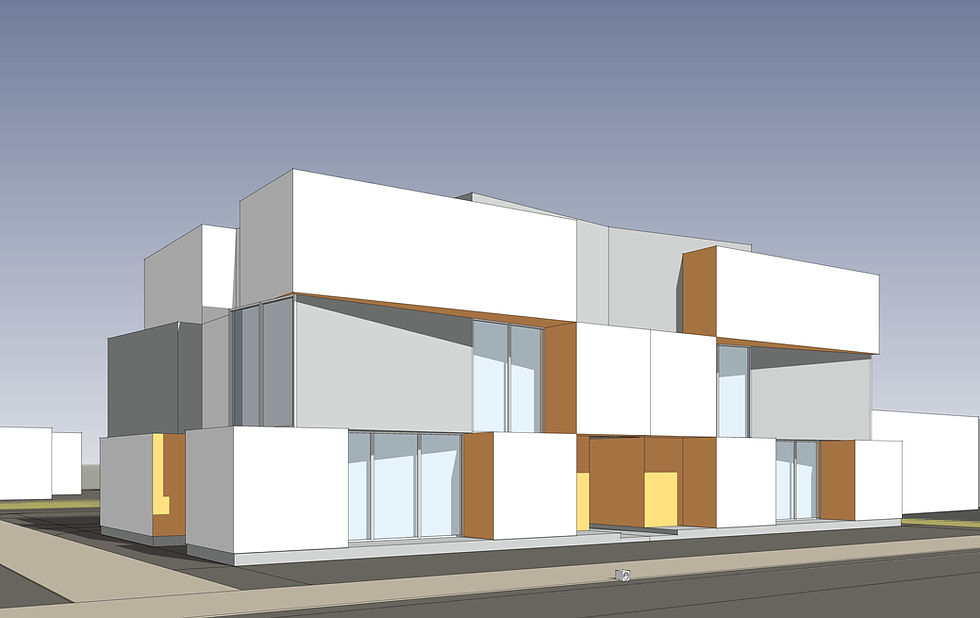
Cluster housing developments create an important opportunity:
To move from isolated residences…to architectural systems that generate community, climate, and experience.

This is where Latin American principles become powerful:
Spatial organization around courtyards and shared spaces
Creation of microclimates
Use of voids as design elements
Strong indoor-outdoor relationships
The goal is not to copy typologies, but to reinterpret intelligent spatial relationships.
Materiality: Reinterpreting, Not Copying
One of the most common mistakes is trying to replicate Latin American materials in contexts where they do not belong.
The key is translation, not imitation.
Stone → Limestone

In Latin America, stone provides:
Visual weight
Thermal inertia
Handcrafted texture
In Florida, limestone fulfills a similar role:
It is local
It is durable
It integrates naturally into the landscape
Used in plinths, garden walls, or partial façades, limestone creates a grounded and honest architectural base.
Earth / Handcrafted Finishes → Textured Stucco
In Florida, stucco is often flat, repetitive, and characterless.
But within that limitation lies a major opportunity.
When applied intentionally — for example, using a 45-degree trowel technique that creates patterns inspired by palm leaves — the material transforms completely:

It introduces human scale
It restores craftsmanship
It creates identity without compromising code compliance
This is not decoration.
It is design through materiality.
Color: Identity Without Falling Into the Obvious
In Latin America, color is not arbitrary.
It is climate, culture, and orientation.
In Florida, these principles can be reinterpreted thoughtfully through:
Light tones that reduce heat absorption
Natural palettes connected to the surrounding environment
Controlled accents at entrances and transitional spaces
The mistake would be to saturate everything with color.
The success lies in using color as:
a spatial tool, not cosmetic treatment.
Water as Climate, Reflection, and Atmosphere

The reflecting pools emerge as a contemporary reinterpretation of Florida’s close relationship with the sea and coastal landscape. More than decorative elements, they are intended to bring the presence of water into the architectural experience, using reflections, movement, and light to create a fresher and more sensory atmosphere.
As they integrate with the project’s material palette — limestone, textured stucco, and tropical vegetation — the water strengthens the connection between architecture and its surroundings. In this way, the landscape is no longer perceived as a separate element, but as an active part of the project’s spatial and climatic experience.
Architecture as Identity
The ultimate goal is not for someone to say:
“This looks Latin.”
The goal is something deeper:
Spaces that feel coherent
Materials that feel honest
Climate that is properly addressed
Identity that does not feel forced
That is where the true signature of a design studio begins to appear.
An Architecture That Remembers Where It Comes From
In a world where many cities are beginning to look the same, architecture risks losing something essential: its ability to belong.
For years, urban development has prioritized speed, repetition, and standardization.
The result has been architecture that is efficient… but often disconnected from climate, materiality, and the culture surrounding it.
That is why today, more than ever, designing with identity becomes a responsibility.
Not to replicate the past.Not to romanticize “Latin” culture.And certainly not to turn culture into a superficial aesthetic.
The real opportunity lies in reinterpreting the principles that have always defined Latin American architecture:
adaptation
material honesty
climatic responsiveness
and human connection
Bringing this logic into Florida does not mean importing an image.
It means designing spaces that understand heat, light, humidity, landscape, and the way people truly live.
Because ultimately, the most valuable architecture is not the one that tries to look like it belongs somewhere.
It is the one that truly does belong…without forgetting where it comes from.